Why is waterproofing important for accessories? A sudden shower can soak a canvas bag, while splashes may damage a phone pouch or leave marks on a leather wallet. Water can also weaken adhesives, encourage corrosion on metal fittings, and cause some materials to warp or lose their finish. A suitable water-resistant treatment helps reduce these risks and keeps everyday items useful for longer. Small details matter. A coated surface may shed droplets, but exposed seams, stitching, and zippers can still let moisture through. In practice, the weakest point often determines how well an accessory handles wet conditions.
Waterproofing is not a guarantee against every kind of water exposure. The words “water-resistant” and “waterproof” can describe different levels of protection, so product labels and care instructions deserve a close look. A brief splash is not the same as prolonged soaking. Not even close. Material choice matters, too: a treatment that suits synthetic fabric may not be appropriate for untreated leather. For makers, retailers, and buyers, understanding these limits supports more accurate product choices and clearer expectations. This guide explores common waterproofing methods, their practical benefits, and the details that can be overlooked. Some claims sound reassuring. They still need evidence. A well-protected accessory can handle daily moisture better, but careful use and proper maintenance remain part of the picture.
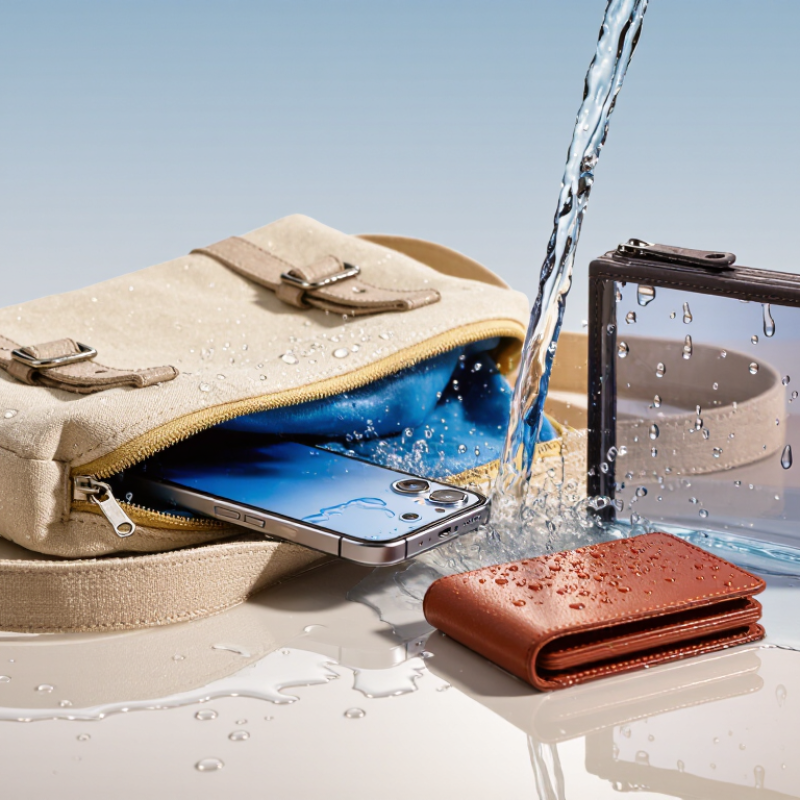
Why Is Waterproofing Important for Accessories?
Waterproofing matters because a splash can reach the places users rarely notice: a charging port, stitched seam, or button opening. IEC 60529 defines the IP code for classifying protection against water ingress. In an IPX rating, “X” means the enclosure has no stated dust-protection rating; it does not mean the accessory is untested. The water digit describes performance under controlled test conditions, not every situation outdoors.
The scale runs from IPX0, with no water protection, through IPX8, for specified immersion. IEC 60529 lists IPX1 for vertical dripping and IPX2 for dripping when tilted up to 15 degrees. IPX3 covers spraying; IPX4 covers splashing. IPX5 and IPX6 test water jets of increasing force. IPX7 tests temporary immersion at a depth of 1 metre for 30 minutes. IPX8 covers continuous immersion beyond IPX7 conditions, with depth and duration agreed and stated for the product. These figures come from IEC 60529:1989, including its 1999 and 2013 amendments.
A higher number is not a universal promise. An IPX7 result, for example, does not automatically establish protection against powerful jets, which are tested under IPX6. Nor does an IP rating describe resistance to salt, detergent, or wear around a frequently opened port. Real use is messier. Check the test conditions and inspect seals after damage; ratings are useful evidence, not magic.
Water exposure can damage accessories or affect their safe operation. IEC 60529 classifies enclosure protection against water from IPX0 to IPX8.
Bars show the IPX rating number, an ordinal classification—not a measured amount of waterproofing or a guarantee that protection increases in equal steps. IPX7 covers temporary immersion under standard test conditions up to 1 metre for 30 minutes. IPX8 covers immersion under conditions specified for the product, which are more severe than IPX7; its depth and duration are not universally fixed. Check the stated conditions and choose a rating suited to the accessory’s expected exposure.
A splash-resistant label can sound reassuring, but it does not tell you how an accessory handles immersion. IEC 60529:2013 defines the IP code used to classify protection from water and solid objects. Its IPX7 benchmark tests an enclosure under temporary immersion: up to 1 metre of water for 30 minutes. The “X” means no dust-protection rating is specified. That distinction matters for earbuds, wearable devices, and charging cases, where water can reach seams, buttons, or charging contacts.
A lab result is a controlled snapshot, not a promise for every situation. The test does not establish protection against deeper water, forceful jets, or repeated exposure. Worn seals can also behave differently from new ones. A damp accessory may look fine, then fail later. That gap deserves attention. For product teams, IEC 60529 offers a recognized benchmark; clear care instructions and repeat testing help make the rating more useful to buyers.
Tips: Check the exact IP rating before use. Keep charging ports dry, and let accessories air-dry fully before charging. Don’t treat IPX7 as permission for prolonged swimming or hot-water exposure.
Water can enter an accessory through a loose seam, worn seal, or uncovered charging port. A few drops may seem harmless. Inside, moisture can form a thin film between metal parts, including contacts, screws, and springs. When water carries salts or dirt, corrosion may develop faster. The surface can turn dull or greenish, while electrical contacts may become less reliable. A device might still work at first, which makes the damage easy to miss.
Electronic components face a different but related risk. Moisture can bridge nearby conductive points and disrupt a circuit. After drying, residue may remain and continue to attract moisture. That can cause intermittent charging, unresponsive buttons, or sudden shutdowns. Not every exposure leads to failure; water type, exposure time, and construction all matter. Still, “water-resistant” does not mean invulnerable. A small gap matters.
Good waterproofing uses well-fitted seals, protected openings, and materials suited to repeated wetting. Regularly check seals for cracks or deformation, especially after drops or frequent use. If an accessory gets wet, disconnect power when safe, dry the exterior, and let it air-dry before charging. Avoid heat that could warp plastic or seals. One detail is easy to overlook: a case may look dry while moisture remains around a connector. Protection helps, but it cannot guarantee that water will never get in.
Accessories face more than heavy rain. A damp pocket, sweaty hand, or splash beside a sink can send moisture toward seams, charging contacts, or inner padding. The right protection depends on an item’s shape, materials, and likely exposure. No seal lasts forever.
Gaskets form a physical barrier where parts meet, such as around a lid or button. They need even pressure; a twisted gasket can leave a narrow path for water. Hydrophobic coatings help droplets roll off surfaces, but they cannot seal openings. They may also wear down where straps rub against a desk or bag. Membranes add a thin protective layer and can allow some vapor to escape, reducing trapped condensation. Small details matter. Performance varies with wear and construction, so test the finished accessory, not just its raw materials. Even careful designs can fail at a neglected seam.
Tips: Check closures and seams after use, then let accessories dry before storage. Clean gently around gaskets. When comparing products, look for the test conditions behind claims of water resistance; the word “waterproof” alone tells you little.
Waterproofing matters because a tiny gap around a button, charging port, or stitched seam can let moisture reach sensitive components. Validate the finished accessory, not just its material samples. IEC 60529 defines IP protection: the first digit covers solid particles, while the second covers water. For example, IPX7 testing includes temporary immersion in water up to 1 metre for 30 minutes under specified conditions. Small gaps matter.
Corrosion needs a separate check. ISO 9227’s neutral salt-spray method uses a 50 ± 5 g/L sodium chloride solution at 35 ± 2°C. It helps reveal weaknesses in coatings, plating, and exposed metal parts, such as rust around a buckle or connector. But salt-spray hours do not translate directly into years of real-world service. A passing result is not a lifetime promise.
Tips: Test representative production units with their actual seals, fasteners, and cable openings. Record the IP test conditions and salt-spray duration, then inspect for leaks, blistering, and corrosion. Repeat tests after wear or assembly changes. That extra step can feel slow, but skipping it leaves a blind spot.
Through a loose seam, worn seal, or uncovered charging port. Even a few drops can matter.
It can leave a thin film on contacts, screws, and springs. Salt or dirt may speed up corrosion, leaving surfaces dull or greenish.
Yes, at first. Residue may remain after drying and later cause unreliable charging, unresponsive buttons, or sudden shutdowns.
No. A small gap can still let moisture inside. The label is not a guarantee.
Disconnect power when safe, dry the outside, and let it air-dry before charging. Avoid heat, which may warp seals or plastic.
Under IEC 60529, its first digit relates to solid particles and its second to water. For example, an IPX7 test includes immersion up to one metre for 30 minutes under specified conditions.
ISO 9227 salt-spray testing can reveal weaknesses in coatings and exposed metal. Look for rust near a buckle or connector.
No. Test hours do not translate directly into service life. It is easy to overread that result.
Test finished units with their actual seals, fasteners, and cable openings. Record test conditions, inspect for leaks or corrosion, and repeat after design or assembly changes. A case may look dry while a connector stays damp.
Why is waterproofing important for accessories? Water can seep into small openings, corrode metal parts, and disrupt or permanently damage electronic components. The IEC 60529 system describes water-ingress protection from IPX0, which offers no rated protection, to IPX8, which covers immersion under conditions specified for the product. A common reference point is IPX7: protection during immersion in up to 1 metre of water for 30 minutes under the standard’s test conditions.
Accessories can use fitted gaskets to seal joints, hydrophobic coatings to help repel moisture, and membranes that block liquid while allowing air to pass. These measures should be validated rather than assumed to work. IP ratings indicate tested levels of ingress protection, while ISO 9227 salt-spray testing can help assess resistance to corrosion in salty environments. Together, suitable design and testing help accessories remain dependable through everyday exposure and use.

Vivi Auto Accessories